Mountain Meadows Massacre Timeline

Most of the details on this post are taken from William Bagley’s book.  Will Bagley is a historian specializing in the history of the Western United States and the American Old West. Bagley has written about the fur trade, overland emigration, American Indians, military history, frontier violence, railroads, mining, and Utah and the Mormons.

His book  Blood of the Prophets,  won numerous awards, including a Spur from Western Writers of America and best book awards from the Denver Public Library and the Western History Association. The New York Review of Books described the study as “an exhaustive, meticulously documented, highly readable history that captures the events and atmosphere that gave rise to the massacre, as well as its long, tortuous aftermath. Bagley has taken great care in negotiating the minefield presented by what remains of the historical record.”

Another section is taken from Juanita Brooks book “The Mountain Meadows Massacre

Juanita Brooks is a historian and author whose ancestor took part in the MMM.

Other sources will be linked to, as well as key information from either of these authors.

Spring 1845 Parley P. Pratt publishes pamphlet identifying mormonism as “Kingdom of God on earth” “The revolutionary purpose of the Kingdom of God and its millenial plan is to reduce all nations and creeds to one political and religious standard, and thus put an end to the battle of forms and names, and to strife and war. The earth’s rulers must take a lively interest with the saints of the Most High and the covenant people of the Lord, or you will become their inveterate enemy.”

Sometime in 1845 Oath of Vengence added as part of the temple introduction at the veil

Mar 1849 Brigham Young to the Council of Fifty, “I want their[adulterers] cursed heads cut off that they may atone for their sins.” “Grant advised sinners to ask Brigham Young to appoint a committee to attend to their case, and let a place be selected, and let that committee shed their blood. ”

Dec 19, 1856 “President John M. Higbee spoke of the benefits of the Society, and of us not encouraging those blood-sucking Gentiles that bring us their goods.” (Bagley)

Dec 21, 1856: “Elder Rufus Allen made remarks on the necessity of the Saints being faithful in all circumstances and of doing the will of the Lord in all things. President John M. Higbee made remarks on the necessity of us as Saints living in subjugation unto those who are placed over us in the Lord (Cedar City Journals)

Apr 16, 1856 “Will you love that man or woman well enough to shed their blood?” – Brigham Young, Deseret News, April 16, 1856

Jan 18, 1857 “”Elder Richard Harrison, having returned from the Legislature, arose to address a large assembly of the Saints: ‘The time has come that we cannot fool with the Almighty. If we do right, we can get forgiveness. The most damnable sins of this people are disregard unto the authorities[Meaning the leaders of the church]*.” (Cedar City Journals)

Jan 14, 1857 Nauvoo Legion re-instated

Feb 1, 1857: “Richard Harrison arose and said ‘We have to bring ourselves into subjugation to the proper authorities, and got to reform in everything, and make things right.”  Mormon Reformation

Apr. 1857  Fancher, Baker, Mitchell, Dunlap, Cameron, and other families leave their homes in Arkansas for California. (Innocent Blood Timeline)

May 13, 1857 Pratt murdered by jealous ex-husband, Hector McLean.  Mclean was an alcoholic who had abused his wife and she had left.  She later married Pratt.  McLean continued to blame mormonism as the cause.

Spring 1857 Buchannon sends army to investigate

July 1857  “P” speaks to a party in California who met “the Arkansas companies” camped “six miles from Salt Lake” including Fanchers, Camerons, and Dunlaps, waiting for the Bakers. (Innocent Blood Timeline)

9 July, 1857 – Alta, California Newspaper publishes article bragging about Pratt’s death

July 20, 1857 First overland emigrants, mostly from Illinois, arrive in Salt Lake.

July 23, 1857 Elias Smith’s journal, “Parley P. Pratt was one of the apostles, and was in Kansas at Fort Scott and Fort Smith for the purposes of enlightening people on Mormonism. He unfortunately for himself was murdered by the heathen Gentiles. This emigrant train happened to be from the same section of the country in which Pratt was killed. The Mormons were so insulted and indignant over the death and the murder of Pratt that they wreaked untold vengeance on the poor emigrants. This is supposed to be the cause of the Mountain Meadow Massacre.” — quote from Ann Gordsley, John D. Lee’s youngest widow. Eleanor Pratt arrives with Porter Rockwell.

24 July 1857 “Our independence was declared as a free people by Brigham Young and his counselors” The journal records all said “Amen”.

July 26, 1857 “We discussed our enemies” -Brigham Young meeting with Apostles

Aug 1st, 1857 – “I took Eleanor Pratt’s statement on the murder of Parley P. Pratt.” Diary of Wilford Woodruff

August 2, 1857 “Brigham Young publicly discusses the possible secession of the Mormon theocracy from the United States and the establishment of an independent kingdom (Young 1857b, p. 98).

August 3, 1857 George A. Smith leaves Salt Lake for the south. Fancher party “arrived in G.S.L. City with a large herd of cattle.

Aug 3, 1857 George A. Smith sets out to tour Southern Utah starting in Parowan

Aug 4. 1857 Brigham Young appoints Jacob Hamblin president of the Southern Indian Mission and orders Fancher party to depart.

Aug 5, 1857 Brigham Young Declares Martial Law (Young 1857). Formal announcement sent out Sept 15th.

Aug. 8 1857 George A. Smith arrives in Parowan.

Aug 15, 1857 Samuel Pitchforth reports Fancher party camped near Nephi. George A. Smith goes to Cedar City Samuel Pitchforth reports Fancher party camped near Nephi. George A. Smith goes to Cedar City

Aug 16 1857 George A. Smith preaches twice at Cedar City. Spends night with J. D. Lee. Brigham Young says in sermon: “I will say no more to the Indians, let them alone, but do as you please. And what is that? It is to use them up; and they will do it.

Aug 17, 1857 A member of the Dukes train, S. B. Honea, stated “that he passed through Great Salt Lake City on August 17, that he saw everywhere preparations for war, that the company were harassed by Indians all the way, that in southern Utah they hired Mormon guides and interpreters to the sum of $1,810, and then were robbed on the Muddy [River] of 375 head of cattle. [George B.] Davis described the Indians who stole the cattle as having among them some with light, fine hair and blue eyes, and light streaks where they had not used sufficient paint. He gave the number of cattle taken as 326 head…..On October 17, the first members of the Duke train of emigrants arrived half-starved at San Bernardino with the Mormon theft of their cattle to add to the tale of the massacre.”

Pitchforth reports Fancher party passes through Nephi.

Aug 18. 1857 George A. Smith “Arrived at Washington City…Preached in afternoon. Dame drilled the militia.” Visited Tutsegabbit

Aug 24, 1857 Woodruff hears Eleanor Pratt describe Parley’s death. George A. and S. S. Smith travel to Beaver (Wilford Woodruff Diary)

Aug 25, 1857 George A. Smith camps near the Franchers at Corn Creek, Jacob Hamblin suggests they continue the trail and rest at Mountain Meadows, next to his homestead.

Aug 28 1857 Fancher party camps on Indian Creek near today’s Manderfield. Silas Smith has supper with the Fancher party.

Betwen Aug 25th and Sept 6th Stake Presidents William H. Dame and Isaac C. Haight, the senior regional military leaders of the Mormon militia, hold meetings about how to implement Brigham’s “Martial Law”

Sept 1 Hamblin and some twelve Indian chiefs on September first met with Brigham Young and his most trusted interpreter, 49-year-old Dimick Huntington, at Great Salt Lake. Taking part in this pow-wow were Kanosh, the Mormon chief of the Pahvants; Ammon, half-brother of Walker; Tutsegabit, head chief of the Piedes;Youngwuds, another Piede chieftain, and other leaders of desert bands along the Santa Clara and Virgin Rivers. Little was known of what they talked about until recently when it came to light that Huntington (apparently speaking for Young) told the chiefs that he ‘gave them all the cattle that had gone to Cal[ifornia by] the south rout[e].‘ The gift ‘made them open their eyes,’ he said. But ‘you have told us not to steal,’ the Indians replied. ‘So I have,’ Huntington said, but now they have come to fight us and you for when they kill us they will kill you.’ The chiefs knew what cattle he was giving them. They belonged to the Baker-Fancher train.” (“Forgotten Kingdom: The Mormon Theocracy in the American West,” David Bigler, 1998, pp. 167-168.)

“Jacob Hamblin…..decided to take a group of the chiefs to Great Salt Lake City for an interview with the great Mormon chief, Brigham Young. His handwritten diary, as yet unpublished, says: ‘I started for Great Salt Lake City in company with Thales Haskell and Tutsegabit…He had felt anxious for a long time to visit Brigham Young. We fell in company with George A. Smith. Conosh [Kanosh, the Pauvant chief] joined us. Other Indian chiefs also joined our company. When we arrived in the city there were ten of them went up to see Brigham Young, the great Mormon chief. We encamped on Corn Creek on our way up; near a company of Emigrants from Arkansas, on the—–‘

“Here the account stops abruptly, for the next leaf is torn out…..What Brigham Young told the chiefs in that hour was not recorded, but we might hazard an opinion that it was not out of harmony with his written instructions that ‘they must learn that they have got to help us or the United States will kill us both.’…..At that time Brigham Young had to be sure of his allies, for he was conducting a war against tremendous odds. The previous Mormon policy had been to keep the natives from stealing and plundering and to teach them the peaceful pursuits of farming and cattle raising, but now Brigham Young seemed determined that he would no longer “hold them by the wrist,” as he told Captain Van Vliet a few days later. The Indians must have started back home immediately, for in seven days they were harassing the emigrants at Mountain Meadows, and in ten days they participated in the massacre of the company.” (Juanita Brooks, pp. 40-42.)

Sept 3 1857 Jesse N. Smith reports Fancher party at Paragonah. Train arrives later at Parowan and is kept outside the town wall.

Sept 4, 1857 Francher Party arrives at Cedar City, camps west of town.

Isaac Haight, second in command of the Nauvoo Legion’s southern brigade, tells John Lee that he planned to arm the Paiute Indians and “send them after the emigrants.” Two chiefs meet with Haight and John Higbee and receive orders to kill the Fancher party members and take their property as spoil. (Last confession of John D. Lee)

Sept 5, 1857 Rachel Lee records that John Lee heads south and camps with his Paiute war party. Men ordered by Haight and Higbee to participate in the action against the emigrants are told to report to a place in the hills near the ranch of Jacob Hamblin. The Fancher party heads south toward Mountain Meadows.

Sept 6, 1857 Brigham Young, in a sermon, declares that the Almighty recognizes Mormon Utah as a free and independent people, no longer bound by the laws of the United States. Fancher party arrives at Mountain Meadows. Cedar City High Council Meeting votes to “do in” the emigrants and then decides to send a message to Brigham Young asking for orders.

Sept 7th, 1857 – Dawn (Mountain Meadows) The Fancher wagon train from Arkansas, bound for California, is attacked at dawn by Lee, about 60 white men, and their allies.

Emigrants “drew their wagons near each other and chained the wheels one to the other.” James Haslam departs Cedar City late in the afternoon.

Sept 10th, 1857 – Daybreak (Mountain Meadows) – Indians Attack, 1 killed 3 wounded. They break off the attack, and drive off cattle

Haight meets with Dame at 2:00 a.m. and returns to Cedar with orders (innocent blood)

Militia commanders ring the town bell in Cedar City, calling out trusted members of the Nauvoo Legion. Indians attack Dukes train at Beaver.

At dawn Haslam arrives at Young’s office, leaves at 1 p.m. Garland Hurt learns emigrants “on the southern route had got themselves into a very serious difficulty with the Piedes.” Nauvoo Legion leaves Cedar City and arrives at Mountain Meadows about 10:00 p. m. Militia leaders hold a council..

7:00 am (SLC) – Haslam arrives at Brigham Young’s office with Haights letter.  Leaves at 1 p.m. Young, according to published Mormon reports, sends a message back to let the Indians “do as they please,” but–as for Mormon participation in the siege–if they will leave Utah, “let them go in peace.”

12:00 pm (Mountain Meadows) – White, Stewart, Arthur, Wilden, Hopkins and Tate arrive

About noon: “Several men” arrived from Cedar City. Move camp 400 yards. Mormons take pot shots at emigrants. Emigrants chain wagons together.

-1:00 pm (SLC): Haslam departs Brigham Young’s office (Cedar City) Main militia party under Higbee leaves Cedar City

Afternoon: Lee reconnoiters camp and is detected; emigrants send out two little boys. Lee persuades Indians not to kill the boys. Stays on west side two hours.

Afternoon: "the messenger from Cedar City returned. He said that President Haight had gone to Parowan to confer with Colonel Dame, and a company of men would be sent out to-morrow (Friday). "The Indians and men were engaged in boiling beef and making their hides up into lassoes."

Nightfall: Three emigrants (including Abel Baker, Joseph Miller, and "William B. Jones, Caldwell County, Missouri"?) leave the wagon fort for the California Road.

Evening: Militia arrives from Cedar [232]. Total force now 54 whites "and over three hundred Indians." All-night council held.

10:00 pm: Nephi Johnson, Higbee, and Militia arrive at Mountain Meadows.

Sept 11, 1857 SUMMARY The Wagon train gives up their guns, and are executed “order 66” style by the men they are riding next to. 120 killed 80 women and children, mostly children.

Mormon leaders devise a plan to end the stand-off. Carrying a white flag, Mormons meet with members of the Fancher party and pledge the emigrants safe passage back to Cedar City as a way of getting them to give up their arms. The Fancher party is divided into two wagons, carrying the wounded and the youngest children (“the innocent blood”), with the older children and women marching behind, followed by the men, marching in single file. The men are led off to a place near the side of the road where Higbee orders a group of Mormons guards to begin the killing: “Do your duty!” A quarter of a mile away, John Lee leads the wagons until they reach a point where Nelphi Johnson orders the slaughter of the women and older children. Men rush at the party from both sides, and the killing continues amidst “hideous, demon-like yells.” It is over in just a few minutes. 120 members of the Fancher party are dead. The youngest children, those under about age seven, are taken away.

Day of the actual Massacre

Friday, Sep 11, 1857

A Utah Indian tells Garland Hurt, “the Mormons had killed all the emigrants.”

Daylight: Council breaks up “a little before daylight.”

Morning: After breakfast, Johnson and Shirts “place the Indians in ambush.”

Morning: Higbee “directed me to explain the whole plan” to the men.

12:00 pm ?: Lee and Batemen enter emigrant camp

1:00 pm: Powers, with Mathews/Tanner train, arrives at Cedar

Noon: “or a little after,” Lee meets “Hamilton” and enters the camp with the wagons. Emigrants are burying “two men of note among them.”

Afternoon: “four wagons drove up with armed men….a council meeting was called.” They pray. Higbee gives orders: “This emigrant camp must be used up.” Higbee tells Lee that Stewart, White and another man had killed Aden and wounded “a Dutchman” who had escaped on Tuesday night at Richey’s Spring. Higbee says the wounded man “was tracked back, and they knew he was there.”

Afternoon: Ira Allen and Robert Wiley reprove Lee, say emigrants would “raise h-l in California.” Lee leaves and [col. 4] Hopkins persuades him to come back and let the priesthood have its way. Higbee says “the emigrants must be decoyed but through pretended friendship.” When Lee protests about innocent blood, “have they not boasted of murdering our Patriarchs and Prophets, Joseph and Hyrum? Now talk about shedding innocent blood.” Lee “had every man speak and express himself. All said they were willing to carry out the counsel of their leaders.” Lee says, “You can do as you please, I will not oppose you any longer.”

4:30 pm: Emigrants leave camp and begin march up Mountain Meadows

5:00 pm: The massacre at Mountain Meadows.  Camp members are slaughtered near the rim of the great basin. Men and women are killed by having throats slit ear to ear.

7:00 pm?: Higbee, Klingensmith, Stewart, and Lee search for valuables.

8:00 pm?: Higbee, Klingensmith, and Lee make speeches.

Night: Lee sleeps at Hamblin’s ranch; “slept soundly until next morning.”

Night: Warn, with Mathews/Tanner train, reports Haight and Dame leave Cedar for the Meadows

Aftermath

Sept 12, 1857 Col. Dame and Lt. Col. Haight visit the massacre site with John Lee. Dame seemed appalled at what he saw and said, “I did not think there were so many of them [women and children], or I would not have had anything to do with it.” Dame’s comment angered Haight, who expressed concern that Dame might try to throw the blame on him for an action that he ordered. (Lee’s account) The men pledge to keep Mormon participation in the massacre secret.

Sept 13, 1857: Lee and Indians arrive at Harmony, where Lee stages a feast.

“At ten o’clock a.m. meeting opened by singing. Patriarch Elisha H. Groves spoke upon the principles of the gospel, and of the Lamanites being the battle-axe of the Lord, and of our faithfulness to the gospel. 2 p.m. meeting opened by singing, prayer by I. C. Haight. Haight spoke upon the spirit of the times, and of cousin Lemuel being fired up with the spirit of their fathers. Singing, benediction by P. K. Smith.” [Philip Klingensmith.]

The messenger sent to ask of Brigham Young what to do with the emigrants at Mountain Meadows returns to Cedar City and presents a letter from Young to Isaac Haight. “Too late, too late,” Haight says as he reads the letter and begins to cry.

Sept 14. 1857 Ira Hatch and others kill the last of the Fancher party messengers. (note: Undertaking to cover sins?) Brigham Young writes to Dame that martial law is enacted.  Individuals are instructed to do everything with peace.

Sept 15, 1857 Brigham Young issues a proclamation (of questionable legality) declaring martial law in the Utah Territory. The proclamation prohibits “all armed forces…from entering this Territory,” orders the Nauvoo Legion to prepare for an invasion, and prohibits any person from passing through the Territory without a permit from “the proper officer.”

Sept 16 – 17 Brigham Young hears his first reports concerning Mormon participation in the massacre at Mountain Meadows. (no sources cited for this in any timeline)

Sept 20 John Lee leaves for Salt Lake, where he will provide Young with a detailed account of the massacre. Arapene tells him some details on this day.  According to Lee, Young first expresses dismay and concern that the massacre will damage the LDS reputation. The next day, however, Young tells Lee,

“I asked the Lord if it was all right for the deed to be done, to take away the vision of the deed from my mind, and the Lord did so, and I feel first rate. It is all right. The only fear I have is from traitors.” — Lee account, transcribed by his lawyer

Sept 23 1857 Pete tells Garland Hurt Paiutes “participated in the massacre of the emigrants, but said that the Mormons persuaded them into it.” Lee meets Hamblin and tells him of the massacre. (Brooks 252)

Sept. 27 1857 Lee speaks at Provo. Garland Hurt escapes Nauvoo Legion. (Innocent Blood timeline)

Sept 28, 1857 Lee arrives in Salt Lake and meets with Young.

Sept 29, 1857 Lee tells “awful tale of blood” to Young and selected Mormon authorities, including Wilford Woodruff.  (Wilford Woodruff Journal for this date)

Sept 30, 1857 Indian agent George Armstrong reports massacre to Young. Matthews reaches San Bernadino with news of massacre.

Oct. 2 1857 Massacre participants Klingensmith, Haight, Dame, and Charles Hopkins meet with Brigham Young.

Oct. 3 1857 LA Star publishes first rumors of the massacre.

Oct. 7 1857 Mormons and “Indians” steal cattle from the Dukes train.

Oct. 12. 1857 A mass meeting in Los Angeles denounces massacre.

Oct 17, 1857 First members of the Dukes train arrive at San Bernardino. Star and Alta California publish detailed reports on the massacre

October 1857 The San Francisco Bulletin calls for “a crusade against Utah which will crush out this beast of heresy forever.”

Nov 1857 Lee writes a fictionalized report of the massacre, attributing all the killing to the Indians, and sends it do Young.

Dec 4, 1857 Garland Hurt submits first federal report of the massacre and says John D. Lee recruited Indians to attack emigrants.

Jan 6, 1858 Brigham Young submits a report to the Indian Commissioner laying the blame for the massacre on mistreatment of Indians by non-Mormons. Claims as the “natural consequence” of poisoning at Corn Creek, the Fancher party fell “victims to the Indians’ wrath.”

February 25, 1858 Thomas Kane, sent to Utah by President Buchanan to attempt to work out a peaceful solution to the Utah problem, arrives in Salt Lake City.

March 18, 1858 Congress debates the massacre at Mountain Meadows. It orders an inquiry.

April 1858 Alfred Cumming, the newly appointed governor of Utah sent from Washington, arrives in Salt Lake to assume office. Cumming announces that he will head south to begin an investigation of the massacre. Young assures Cumming that he is also determined to get to the truth of the matter, and Cumming seems to believe him.

May 11, 1858 Gov. Cumming declares the California trail open and says emigrants can once again “pass through Utah territory without hindrance or molestation.

June 1858 Hamblin tells Young and Smith “everything I could” about the massacre.

June 26, 1858 Federal troops (one-fourth of the United States Army) march through Salt Lake City toward their headquarters at Camp Floyd, forty miles away. They do so after Young, recognizing the overwhelming size of the federal force, accepted federal terms-Brigham Young pardoned for treason

July 8, 1858 New-York Times reports John D. Lee’s involvement in “the Mountain Meadow Massacre.”

August 6, 1858 George A. Smith, one of the twelve apostles in the LDS Church, begins drafting an apostolic report on the massacre. The report blames the emigrants for inciting Indians. It also places John Lee at the scene, thus identifying him as the best possible Mormon scapegoat for the crime.

April 1859 Judge Cradlebaugh issues arrest warrants for John D. Lee, Isaac Haight, and John Higbee. The men, all accused in connection with the Mountain Meadows murders, flee.

May 1859 Indian agent Forney retrieves 17 orphans and U.S. Army and Judge Cradlebaugh investigate the massacre.

May 5-6, 1859 The army and Judge Cradlebaugh inspect the massacre scene. Skulls, bones, masses of women’s hair, and bits of clothing still litter the scene. Remains of the victims are buried by troops. Cradlebaugh follows up his visit with a letter to President Buchanan outlining his conclusion that the murders were committed “by order of council.”

May 12, 1859 An arrest warrant is issued for Brigham Young. He appears voluntarily before Judge Joseph Smith (in a Mormon probate court) to give a statement about the massacre, in which he accused of being an accessory after the fact. The case is apparently dismissed for lack of evidence.

May 17, 1859 Att. Gen, Black orders judges not to use Army to support prosecutions, effectively ending the federal investigation.

May 25, 1859 – “Major Carleton, of the first dragoons. In a despatch to the assistant adjutant-general at San Francisco, dated Mountain Meadows, May 25, 1859, he says: ‘A Pah Ute chief of the Santa Clara band, named Jackson, who was one of the attacking party, and had a brother slain by the emigrants from their corral by the spring, says that orders came down in a letter from Brigham Young that the emigrants were to be killed; and a chief of the Pah Utes, named Touche, now living on the Virgin River, told me that a letter from Brigham Young to the same effect was brought down to the Virgin River band by a man named Huntingdon.’ A copy of the major’s despatch will be found in the Hand-book of Mormonism, 67-9. Cradlebaugh says that after the attack had been made, one of the Indians declared that a white man came to their camp with written orders from Brigham to ‘go and help to whip the emigrants.’ ” (“History of Utah,” p. 561.)

June 3, 1859 The federal case against 38 Mormons for the massacre is essentially dropped when the U. S. Marshal declares his unwillingness to make arrests without federal troops to protect him from local citizens, and that help is not provided.

1860 With the Union ready to split apart, interest in prosecuting the Mountain Meadows massacre begins to wane. In Utah, Governor Cumming is unwilling to press prosecution, which he sees as futile:

“God Almighty couldn’t convict the butchers unless Brigham Young was willing.”

May 30, 1861 Brigham Young tours Mountain Meadows

“Vengeance is mine, saith the Lord.” -mass grave marker.

He later speaks at John D. Lee’s Grave:

“President Young said The company that was used up at Mountain Meadows were the fathers, mothers, brothers, sisters, and connections of those that murdered the prophets. They merited their fate, and the only thing that ever troubled him was the lives of the women and children, but that under the circumstances, this could not be avoided.”

1862 With the onset of the Civil War, federal troops leave Utah.

March 1864 John D. Lee, a man with a domineering personality who repeatedly boasted of his role in the massacre, is relieved of his position as elder of the Harmony, Utah branch of the LDS. It appears the Nauvoo records of sealings are altered at this point, John D. Lee being the only person in the history of Nauvoo to have a divorce, had all of his wives and children divorced from him in the records.

April 23, 1866 They (the Mormon townspeople) sent messengers requesting that the Paiutes go into town and hear a letter read to them. Many did. They gathered in the meetinghouse to hear Bishop William Allred address them. According to a previous plan, the Circleville men who outnumbered the Indians three to one came in unarmed and intermingled with them. The bishop read the message from Fort Sanford, stressing that the settlers wanted only peace with their band, but the Indians would have to help by lending them their guns. In return, the Paiutes could work for the whites and be paid in goods. When the Indians showed reluctance to give up their weapons, the settlers acted: “each man knowing his place and what was expected of him, grabbed hold of his Indian to disarm [him]. They all showed resistance but their bows and arrows and knives were taken from them.” Next, “their arms were tied to a stick which was passed behind their backs and under their arms.”

1868 Gov. J. Wilson Schaffer, appointed by President Grant, abolishes the Nauvoo Legion. The Mormon political condition generally begins to deteriorate.

1870-1871 Charles W. Wandell, under the pen name “Argus,” writes a series of stories in the Utah Reporter challenging Brigham Young’s response to the Mountain Meadows massacre. Wandell’s articles eventually produce the first confession by a massacre participant. About this time, Young meets with Lee, Haight, Dame, and others involved in the massacre. Historians suggest that Young singles out Lee to take the blame, confident in the belief that Lee will do as he is told at any trial. Lee is excommunicated on Oct 8 1870.

Oct 8 1870 Lee, Haight, and George Wood are excommunicated from the LDS church “for Committing a great Sin.”

April 10, 1871 Philip Klingensmith, a former LDS bishop who subsequently left the Church, appears in a Nevada court and swears out an account of the massacre, including his own role in it.

1874 Congress passes the Poland Act, which redefines the jurisdiction of courts in Utah. The law restricted the authority of Mormon-controlled probate courts and opened Utah juries to non-Mormons. The Poland Act finally makes prosecution for the murders at Mountain Meadows a real possibility.

Sept 1874 The first grand jury called under the Poland Bill indicts Lee, Dame, Haight, Higbee, Klingensmith, Stewart, Samuel Jukes, George W. Adair, and Elliot Wilden (or Willden) for the murders at Mountain Meadows.

October 1874 Arrests warrants are issued for Lee, Higbee, Haight, Stewart, Wilden, Adair, Klingensmith, Jukes, and Dame.

Nov 7-8 1874 John Lee, a fugitive for fifteen years, is captured in a chicken coop near Panguitch, Utah. Soon thereafter, federal authorities arrest William Dame.

July 23,1875 The trial of John Lee opens in the courtroom of Judge Jacob Boreman. Payment for Lee’s defense is arranged by Brigham Young. The prosecution’s star witness is Philip Klingensmith.

Aug 5, 1875 The trial of John Lee ends in a hung jury, with the nine Mormon jurors voting to acquit and the three non-Mormon jurors voting to convict. The trial, however, severely tarnishes the reputation of the LDS Church in the eyes of most Americans.

Summer 1876 Prosecutor Sumner Howard, the new U. S. attorney for Utah, makes a deal with Brigham Young. Young agrees to find witnesses to convict John Lee in return for his affidavit being placed in evidence (largely exonerating him) and charges are dropped against William Dame and other Mormon officials.

Sept 15, 1876 The second trial of John Lee opens in Beaver, Utah. Numerous Mormons testify against Lee, but the testimony does not implicate other Mormons. Lee asks that no witnesses testify in his behalf.

Sept 20, 1876 After only a few hours of deliberation, an all-Mormon jury convicts John Lee.

Winter 1876-77 While his appeals play out, John Lee writes his autobiography and confession, which he gives to his attorney, William Bishop, and which is later published under the title, Mormonism Unveiled.  The majority of the book is a testimony for Joseph Smith Jr., but criticizes Brigham Young on a few counts.  It only gets the Mormons into Utah before the rest of it is written by Lee’s Laywer, who was dictated to by Lee what to write.

Mar 23, 1877 John Lee is executed by firing squad while sitting on his coffin in Mountain Meadows.

Aug 29, 1877 Brigham Young dies

August 3. 1999 A back hoe’s claw exposes the skeletal remains of men, women, and children massacred in 1857.

Sept 11, 1999 Gordon B. Hinckley, President of the LDS Church, dedicates a new monument to the victims of the 1857 massacre. He says, “[The past] cannot be changed. It is time to leave the entire matter to God.”

Sources

William Bagley and Juanita Brooks, books

http://www.salamandersociety.com/interviews/willbagley/[1]

http://en.wikipedia.org/wiki/Mountain_Meadows_massacre[2]

http://antimormon.8m.com/leeindex.html[3] (John D. Lee Autobiography)

http://law2.umkc.edu/faculty/projects/ftrials/mountainmeadows/leechrono.html[4]

http://www.amazon.com/Innocent-Blood-Essential-Narratives-Mountain/dp/0870623621[5]
Posted in Timelines | 2 Comments

Daggers in the temple

There is a picture on the wikipedia page for the endowment mentioning a dagger:

http://en.wikipedia.org/wiki/Endowment_(Mormonism)

I inquired if anyone knew what the dagger was for:

“I know that in Masonry, the dagger is used with the cable-tow. They symbolism is that if you rush to quickly into the “temple” you will be stabbed, and if you go too slow you will be hung. The dagger is placed against the bare breast at the first of your initiation into the first degree.” –User Book1830

There is a photo of the Salt Lake temple sword in the Signature Books edition of “The House of the Lord” by James Talmage.

The picture comes from a Mark Twain book.  Mark Twain married a prominent mormon who left the faith, so there is a high chance the image is accurate.

In Wife No. 19 (not the greatest source, but a source) they discuss women bathing naked in water and oil in the temple and cutting holes in the garments over the breasts.  I assume that the dagger was used for this.  Still looking for good sources that confirm it.

Posted in Early Church History (1800s) | Leave a comment

Cougars don’t cut corners

It was my freshman year. I had never been to anything like a university before, and the sheer amount of choice staggered me. I found myself going to official functions, one after another.

It was at one of these official pieces that the BYUSA president gave a rousing speech about “Cougars don’t cut corners”. He discussed walking on the corners of the grass, and that each year the university spent $16,000 replacing the corners of grass where students walked.

The he compared it to cutting corners in our jobs, and the rest of our life. He asked us to each promise we’d never cut corners at the school, and that it would be a reminder to not cut corners later in life.

I was young, I was impressionable. I spent the fall dutifully not stepping on corners and judging the people who did.

Then, winter happened. It always does in Utah. And out came the snowplows. Every one of them zipping with poor turn radius, cutting the corners and plowing up grass along with snow. I watched two snow plows tear up ever corner in the Quad (Between the library and the Administration building) and realized I’d been had. The leadership hadn’t left their ivory tower long enough to realize the actual cause of the damage and they were burdening the students with guilt trips to try and correct it.

Of course, I ascribed it to “Imperfect men” at the time, but now I realize that honestly it’s a pretty good metaphor for the church as a whole.

TL;DR: Snowplows were tearing up the grass. BYU leadership placed blame and guilt on students, works as metaphor for the church

Posted in Current issues | Leave a comment

Patriotism, honor and religion for exmormons

Today, the 4th of July, I had the honor of being at an event where the head speaker was a prominent political figure working for Dick Cheyney. 

I’ve often wondered how the people making decisions regarding national spying and wars that seem empirical in nature to me, think about their actions.

In his speech, he said, what sounded to me to be “it’s okay because god changes our nationalism into patriotism” and ” god prevents our spreading of democracy from becoming empire building”.  Along with the implication that we are only a nation because we uphold the traditions of the christian founding fathers and our dear heavenly father.

As an exmormon, the mixing of Mormon religion and policies that stripped out parts of the bill of rights is disheartening.  If I had my drothers, Snow den would have spoken and this guy would be hiding in Hong Kong, pursued by governments everywhere.

But, and here is the thing, I still love my country.  Often it is easy to be jaded after leaving a cultish religion, to be jaded by big systems, government, etc.

But one can still show respect and honor the country, the concepts Franklin and Jefferson stood for, or recent SCOTUS decisions and ignore the pieces of religion mixed mingled with politics.

Happy Jul 4th all!!!

Posted in Current issues | 2 Comments

Recovery Step 2- Anger

Again, I’m no therapist, simply explaining what I’ve seen dozens of times over from a sample of exmormons and ex-Jehova’s Witnesses on reddit and elsewhere.  If you are having issues coping and moving on see a trained professional.

Step 2- Anger

This is the phase most often associated with exmormons.  An important thing to remember is that this is a normal phase of grieving for any loss.  A father dies, a child is lost, there is a normal period of “WHY!!” that occurs.  This phase of grieving for exmormons may take longer than other types of grieving, but it is not a small amount of loss.  Further family members constantly reminding one of the religion, or forcing one to live certain ways can lengthen the anger process.

Characterized by You feel anger, sometimes at your family for not realizing the issues of the church, sometimes your younger self, for falling for it.  Sometimes at the leaders of teh church for “not being honest”.  Sometimes at Joseph Smith Jr. for setting the entire thing up.  Other moments are reeling feelings of foolishness or of an emptiness of life and purpose that fuel rage.

Most common symptoms Long examinations of the church’s history or current dealings that are corrupt.  Finding details and talking about them.  Looking for a fight with family members and friends.  A feeling of a chip on one’s shoulder that is really quite hollow.  A need to check and recheck one’s beliefs.  A total loss of trust with the church system and individuals that may branch into other systems.

Typical phrases in conjunction with this phase

Joseph Lied!

The “so-called” church

It’s a cult

I can’t trust them, why should you?

You are angry and proud

Intellectuals fight the church

Why do you spend so much time fighting an organization that does such good in the world

If I were to leave, I wouldn’t try to tear down other people’s faiths like you

How to move on

First and foremost, realize this is normal.  There’s going to be a period where this happens. Second, realize that it will end.  The steam will pour out.  The anger will die down.  You will live again without the feeling of “fight”.

One of the pathways people have found to peace is to realize how many other systems are similar in the way they alter their histories or manipulate participants.  You are not alone.  Being fooled into such devotion is more the rule than the exception.

Another is to allow the feeling of release to come into your life.  You may have been asleep before, but now you are awake.  Embrace that feeling and start living your life.

A big help to moving on many have mentioned is to move.  Get a new address (Especially outside of Utah) where people don’t have your identity completely tied to the organization.

Finally, whatever route you take it seems everyone eventually finds a passion that fills up the space.  As the anger subsides and the depression passes (We’ll talk more about that later) you’ll find another life goal that fills in the time and effort.  Live it, love it and let it come in.


Posted in Recovery | Leave a comment

Steps of Recovery- Doubt

Step One- Doubt

Not everyone goes through every step.  This is intended to be a basic guide to help people who ARE in these steps to cope and move on rather than an indication that something is wrong if an individual doesn’t have all the steps.

Characterized by You have a shelf of issues you’re uncomfortable talking about.  When leaders talk in sacrament meeting you cringe when you hear certain phrases or talking points you know aren’t correct.

Most common symptoms

 You seek others you can discuss the issues with.  You’ve had the conversation where the other person shuts you down for daring to ask about such things.  You feel nervous, timid, or even afraid of certain websites because they discuss the topic in detail and you’d almost rather not know.

There are moments where you briefly consider “What if it’s not true?” and you quickly remind yourself of all the testimony moments in your life, or simply tell yourself “I know it’s true” rather than entertain the doubt.  You feel shame, guilt, or fear from these episodes.

You marvel at people who can speak freely about topics that are non-standard.  You’ve heard about polygamy and probably mostly dismiss it.  You know that blacks received the priesthood in 1978, but the details are sketchy.  If it doesn’t affect you directly, you let it go and focus on “the work”.

Typical phrases in conjunction with this phase

I don’t really let history get to me

Does this even matter to me?

He was acting as a man, not a prophet

But that doesn’t affect the doctrine, that’s a policy

God works in mysterious ways.  His ways are not our ways

I’m going to wait to find out about that until after this life

I need more faith, I just don’t understand this

Asking questions like this illustrates how proud you are

How to move on

You need to decide if you would really want to know if it was false.

If not, I want you to really consider this.  The answer is non-trivial.  Let’s assume there is an afterlife and the typical christian god is true.  If Joseph Smith Jr. was a fake, then your baptism is, in fact, not valid.  If Judaism is true then that bacon you ate at the ward breakfast could be condemning your soul.  If the FLDS are right, then you’re lost in an apostate church.

Further, you’re paying 10% of every penny you earn towards your wager on truth.  You’re spending countless hours in callings, preparing lessons, etc.

What I’m saying is, this is non-trivial.  It’s not all about “Wanting to sin” it’s about “Return on investment”.  If you invest that much, and end up in Hell, or simply wasting the investment… well that’s not smart.

If so, then I’d recommend you do research.  You’re going to have to take that issue off the shelf and face it head on.  Some good questions to ask:

  1. “How do I know what is true?”
  2. “What level of bias will I accept from both sides on this issue?”
  3. “How could I prove it wrong?”
  4. “What would prove it true without a doubt?”

Now before you start answering these questions, I’d recommend reviewing the wiki on Locial Fallacies.  Logical fallacies abound in church reasoning, and it’s important not only to understand that the thinking can lead you astray but the “why” of it leading you astray and how to correct for it.

Once you remove the logical fallacies and see the issue for what it really is, you’ll probably get a solid answer and belief about something that was on your shelf.  Once you know you can know for certain that these issues have answers, you’ll likely want to explore every issue on your shelf.  Similar time and effort is required on the first few, but then your brain will find shortcuts and you’ll be able to answer several questions at once based on previous research.

With this, we can move on to future issues

Posted in Recovery | Leave a comment

Recovery

I’ve been asked by a few people to discuss recovery from the system over the years, and so I thought to create a new category and to discuss a bit.  I am by no means an expert.

It is a recovery

The first thing to cover is that it is, in fact, a recovery.  It is impossible to pen the feelings and emotions one goes through when one first doubts the teachings of the church, and an order of magnitude above that when one does not believe any more.

Picture yourself on the way to a party.  You’ve been told your favorite actor/actress will be there.  You’ve spent a bundle on clothes, perfume, etc. preparing for this party.  You’ve rented a limo to set a good impression.  Everyone who was ever anyone is going to be there.

When you mention to your friend you rented a limo, he says something that makes you question whether your favorite celebrity is really going to be there.  You put it on the shelf and ignore it.  He was probably just trying to be funny.

Then you get in your limo with your clothes and as you start driving you ask your friend for directions to the party.  He seems confused.  He doesn’t have the location of the party and gets offended you’d dare to ask.  You question more details and he replies getting more and more agitated that you need to have more faith.

Finally, you realize there was never a party with a celebrity.  Not just a party where your favorite wouldn’t be there, but there was no party at all.  You look back at the expenditure, the time and effort, the number of people you bragged about going to the party to, the people you invited to the party, and your expectations.

At first, you’re very depressed.  You had set your hopes on this so much.  It is crushing in the waves of disappointment.

Then you get angry at the “friend” who invited you.  You ask him what he did with the money you paid him for your ticket and he says “It’s mine now, I did with it as I saw fit” and then questions your morality for even daring to ask such a thing.  He belittles you  and you feel depressed again.

Finally you stop the limo, send it back and get out.  Dressed in your fancy clothes your credit card bills for the ridiculously hip clothes you are wearing hit you again.  How will you ever pay for this mistake?  You know that the friend betrayed you.  You remember all the times he bragged about he was going to the party, and how only cool people going to the party really were “With it”.  That he, you and others would laugh at people who didn’t believe in the party.

And then it hits you, he’ll be mocking you with others.  You wonder how many “others” he has invited to parties and not delivered.  You google it, a quick search just to see, and find that he has done it to thousands.  Shocked, you can’t believe you were so taken in.  You find out that many were far more misled that you, giving up spouses, family, fortune and more for their tickets to the party.

You feel sick at the sheer amount of deception.  You read everything there is about the party to try and comprehend how you didn’t see it.  The realization that the signs were all there and you didn’t see them makes you feel foolish.  You wonder if you have any value at all, if a person so gullible has any right to be alive.

And then you reach out.  Someone on some group has a story similar to yours, and you say “Hey, that’s like me”.  You make a comment, and they respond.  You find others who have similar stories of deception.  You connect.  You realize that this is common and you are not broken.

Then it hits you, there are others still headed to the party.  Maybe it’s someone who introduced you to this friend.  Maybe you always knew the friend because your parents were friends of the family.  Whatever the case, you start trying to point out how obvious it is that this “Friend” is taking money and gifts and there will never be a party.  But your family members and acquaintances refuse to listen.  They quote how nice the friend has been to them, or how much better they feel around the friend as evidence that everything is fine.  They treat you just like you treated others who tried to warn you.  You feel dismissed.  Ignored.  Small.  They treat you like a pariah.  “Lesser”.  Only part of a person.  Sometimes as delusional.

You cope, and you move on.  But then something happens.  One day, the anger drops away.  Oh it might be there for a while, rumbling around, but it doesn’t affect your day to day.  You might still associate with groups, but it’s mostly for the friendship, and to lift and help others.  Your life takes on new meaning.  Parties aren’t that big of deal; and maybe you find a real party that actually happens.

And then one day, you don’t have to think about it anymore.

Unless someone you know constantly brings up the “friend” and “party”, and then, “ugh”, you can never get away from it.  Every time you try to forgive the “Friend” you hear the person quote a like the friend told, or talk about how wonderful that party is gonna be and you go through the steps listed above all over again.

That’s the best analogy for the stages I can give.  Of course not everyone’s experience is identical. Some people get mad first, and depressed later.  Others move straight to apathy. The determining factors seem to be the amount spent on the party in dollars, effort, and friendships.  The more spent, the more the anger/depression/foolish stages hit.

I’ll continue with specifics of what I’ve seen work to help people get over each step in later posts.

Posted in Recovery | 5 Comments

Elder Joe J. Christensen, of the Presidency of the Seventy, shouldn’t talk about history

Meet this guy:

president of Ricks College, First Presidency of the Seventy and General Authority. Now, he gave a quote that is so mindbogglingly bad that I’ve saved it for Father’s Day.

“To illustrate how meaningful that prophecy was and how it relates to our day… we need to get some perspective of history.” He [Elder Christensen] pointed out that the quickest Adam and Eve could communicate or travel over long distances was by horse. Almost 6,000 years later, the fastest Joseph Smith could communicate or travel was by horse. No progress in travel in almost 6,000 years of history! But beginning with the Restoration, the Lord began to pour out his Spirit and unveil modern inventions that have enabled us to take the gospel to the ends of the earth.”

(Quoted by Janet S. Scharman, reprinted in the Ensign, W. Jeffrey Marsh, “Training from the Old Testament: Moroni’s Lessons for a Prophet.” Ensign. Aug. 1998. 10)

At first glance it appears profound– truly insightful. But with about 5 seconds of thought it is, in fact, utter bullshit.

First of all, notice the “6,000 years later” bit. This implies that the president of Ricks College was a “Young Earth Creationist,” or that the Bible should be taken literally.

Second of all, if Adam lived 6,000 years ago, that’s about 1,000 years after the Sumerians invented glue, which makes things awkward.

But could Adam simply walk up to any horse and ride it as fast as Frank Hopkins (1865, 20 years after Joseph Smith, but I think it illustrates the point and working Viggo Mortensen into a post is always a worthwhile aspiration)?

I won’t let that bad GA say that all horses are equal, and that you’re fast because of some con-artist.

You see, he skipped all kinds of advancements in travel, such as the domestication of horses which occurred approximately 24,000 years before Adam. He also left out that Nephites shouldn’t have been able to ride horses as there were none on the American continent. Simply because horses exist doesn’t mean one can travel the same speed.

Also, let’s not forget the invention of the wheel (3500 B.C.), which would have made travel significantly faster, attaching teams of horses (1800 B.C.), or the invention of the stirrup (2nd century B.C.). The stirrup was really effective only when attached to a saddle (700 B.C.).

But there was also boat travel. Adam, like the Professor from Gilligan’s Island, wouldn’t have known how to put together a raft to save his life.

“Any idea how to build something to go over that wet stuff, Eve?” “No, maybe we should ask the talking snake.”

The invention of the sailboat (4000 BCE), the magic submersible craft (2200 BCE), square sails (900 BCE), two-masted ships (500 BCE), triangle sails that allow sailors to go forward even against the wind (A.D 900), flax fiber for sails (A.D. 1500), three-masted sails (A.D. 1680), more than three masts (1800)… these are all inventions that marked clear progress in travel and the dissemination of information.

We should also consider that the steam engine was really invented in a way that made it practical to use in 1781 and, by 1883, engines that could provide 10,000 HP had become feasible.

In fact, Joseph Smith, Jr. even knew that there were better modes of travel than by horse.  You see, in 1821, the Erie Canal reached Palmyra, New York, making it the highway between Palmyra, New York and Kirtland, Ohio. It just so happens that the two founding locations of the church were connected by the fastest mode of travel around the same year that Joseph claims to have had a vision that he was to start a new religion (okay, so technically that he was told to join no religion, but if you look up all the scriptures he says Christ said to him during the visit, he would to have had to have been a real dunce not to pick up that he was going to be part of this whole restoration thing).

Think about it. Sidney Rigdon with a ton of converts in Kirtland, waiting for the book, and Joseph Smith, Jr. with his converts in Palmyra… the mail went back and forth faster between those locations than any horse could travel.

Yes, Mr. Joe J. Christensen, you get an “F” in history. We could perform the same confirmation bias on the Wright brothers, pointing out that from Adam to the Wright brothers, all that man could do to travel was on the ground. Clearly they were inspired.

The truth is that small improvements over long periods of time have made all the difference in travel. The real reason for the post-1800s explosion of technology is the discovery of how to use oil, and the bits (that have been coming for thousands of years) needed to understand.

Want to know how inventions spur other inventions? I recommend the BBC series “Connections” by James Burke. Leave the heads of universities to go off and do religious duties and leave history alone.

Posted in GA Bullsh*t | Leave a comment

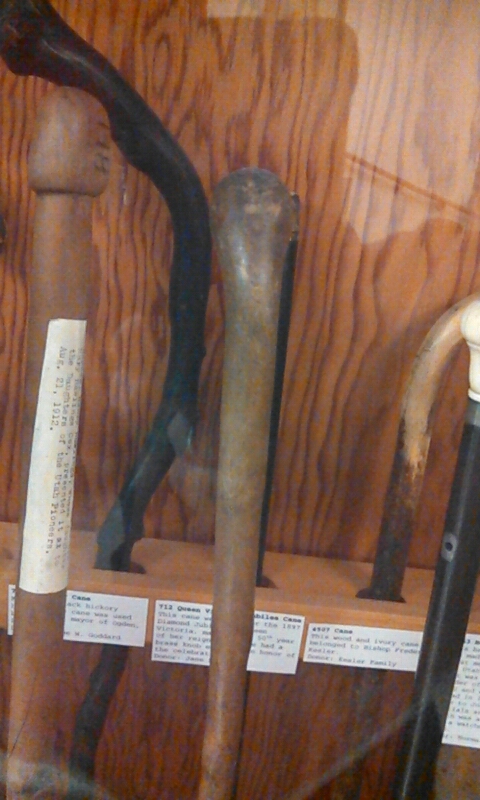
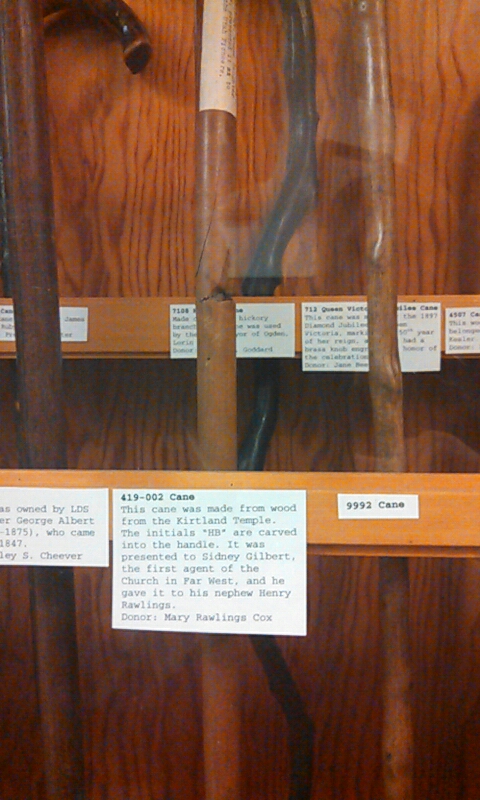
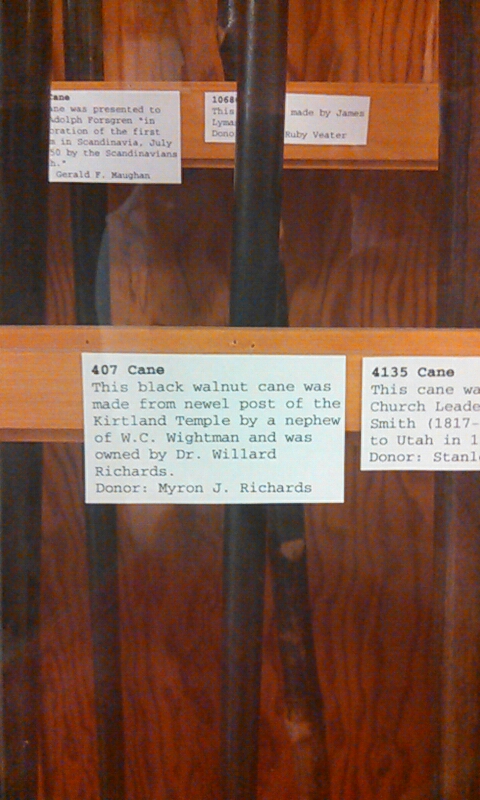
Walking canes, casket sticks, dousing rods and more: A tour of some of the most bizarre items of mormon folklore history and magic

[Skip down to TL;DR for summary]

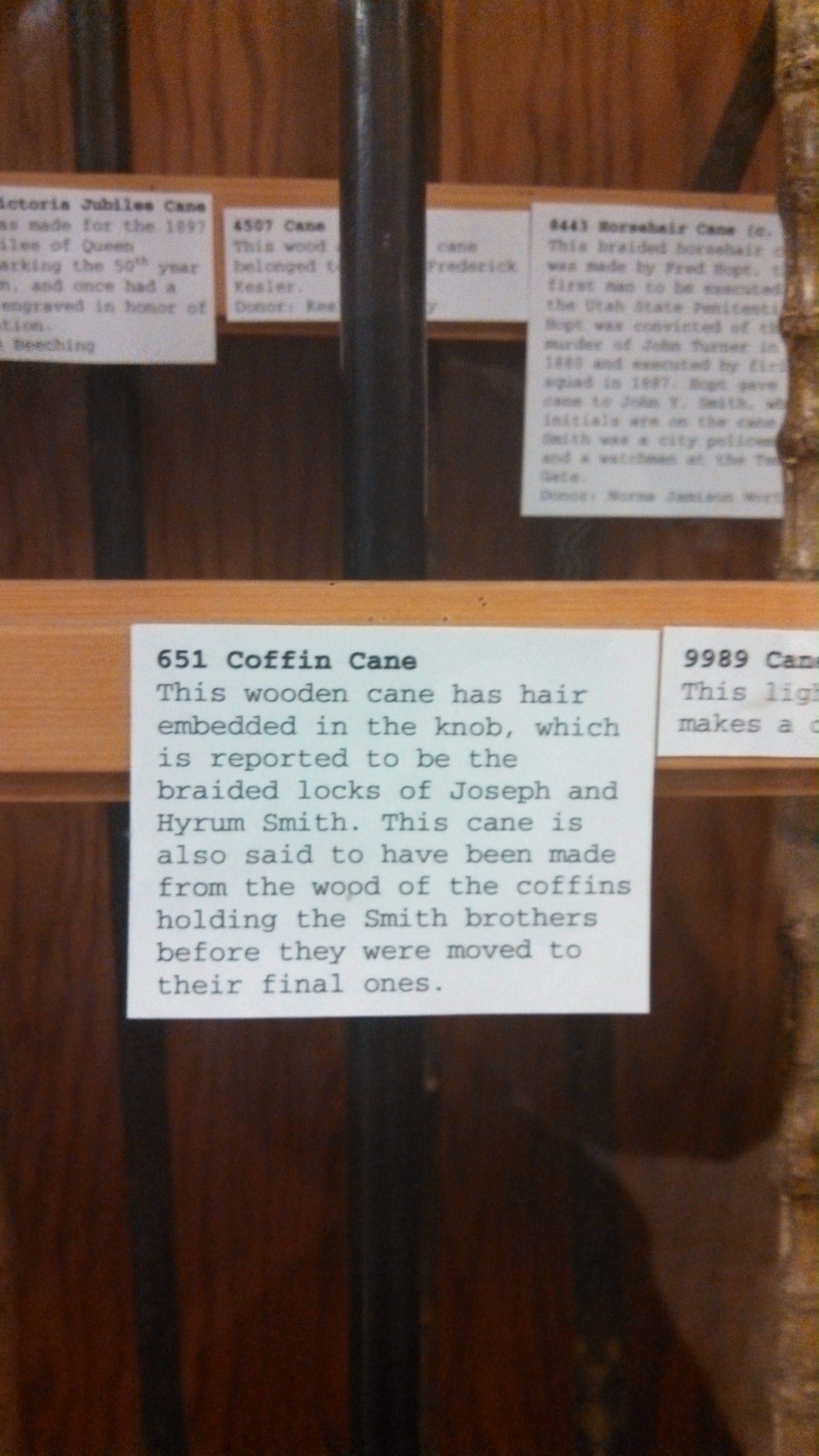
When I was a wee lad, I heard about canes being made out of the caskets that carried Joseph’s and Hyrum’s bodies. I believe it was mentioned in passing by a tour guide at Nauvoo, back before every word stated was dictated by correlation.

This passing comment stuck with me, for whatever reason, and I remember playing as a boy with my action figures having magic sticks that would heal them. When reading Harry Potter, the wands with unicorn hair or phoenix feather cores instantly reminded me of the casket sticks I heard about in Nauvoo.

It’s the cane that chooses the wizard, Harry Potter.

Then, our family traveled again to Nauvoo and Independence, Missouri, and again I heard of the famous canes with braided hair of the dead prophet and his brother in their core. I determined I would have to see one of these before I died. Well, now I have seen them, and a whole lot more. Hang on to your sorting hats, we’re entering the wizarding world of Joseph Smith, Jr.

When the prophet died, they took one of the caskets that he and Hyrum were carried in, and split it up into walking sticks. Rumor has it that twelve of these walking sticks were made, and I think I’ve tracked down eight of them. They were oak sticks with Joseph/Hyrum hair core, and purportedly had magical powers of healing.

Willard Richards, Heber C. Kimball, Dimick Huntington, Wilford Woodruff, Brigham Young, Perrigrine Sessions are all known to have owned one. Joseph Bates Noble, the prophet’s bodyguard who received the Nauvoo legion sword from Joseph, also received a casket stick, and I believe it is his stick that is prominently displayed at the UDOP Museum.  Emma’s walking stick also looks to be one of these casket sticks.

Oak Casket Cane, Hyrum and Joseph hair Core Oak Casket Cane, Hyrum and Joseph hair Core_small

Oliver Boardman Huntington’s journal records the following about the Dimick Huntington cane in  MS, Book 18, pp. 62–64, Archives and Manuscripts Department, Harold B. Lee Library, Brigham Young University, Provo.

Entry Monday, 8 March, 1897 (original spelling and punctuation retained):

I had with me a cane made of the rough box hastily nailed together into body which the Prophet Joseph Smiths ^ was placed after he was murdered and brought to Nauvoo from Carthage.

In the top of the cane was a lock of his hair which was taken from his hed his head after he had been buried 7 months. My brother William took it off as he and my brother Dimick were moving the bodies of Joseph and Hyrum from where they were first buried, in the cellar of the Nauvoo House, to the cellar or pit under a little outhouse that was built exclusively for that purpose. The glass over his face was broken and they saved some of that glass And a piece of that glass covered the hair in the top of the cain, and then a piece of metal with a round hole in the center was over the glass and hair. Through the hole in the metal (aluminum), the hair could be seen.

At the party on that evening the cane and its history became known and was viewed, inspected, admired and handled by each individual, and was constantly on the move until 12 o’clock at night. I was invited to give a history of the cane and of the burial and reburial of the bodies of Joseph and Hyrum Smith, which I did. The cain came into my possession in this way.

It was my brother Dimicks cane in the first place. The whole box that Josephs body was brought to Nauvoo in was sawed up into strips suitable to make walking canes of and divided out among his special friends. After the death of Dimick the cane became Allens, and he told me to take and keep it until he called for it.

He died without calling for it at all.

Wilford Woodruff’s cane was obtained from Emma (Matthias F. Cowley, Wilford Woodruff: History of His Life and Labors):

Before leaving Nauvoo, he paid a visit to Emma Smith to whose life he sought to bring consolation in the hour of her bereavement. She gave him a piece of oak for a staff. The oak had taken from Joseph Smith’s coffin.

Wilford says:

I also obtained some hair of the Quorum of the Twelve Apostles [hair from the heads of Joseph Smith, Hyrum Smith, Samuel H. Smith, and Don Carlos Smith was obtained from Hyrum’s widow, I know of no time he collected Brigham’s hair, for example]

My purpose in getting it was that I might put a part of each of these collections in the knob of my staff as a relic of those noble men, the master spirits of the nineteenth century.

A BYU professor records:

Joseph Smith’s body may have placed in as many as three different coffins in 1844. These would be the rough oak box he was placed in at Carthage, the outer coffin used while the body lay in state at the Mansion House (which was then filled with bags of sand and buried at the cemetery), and the coffin in which the body was buried secretly in the basement of the Nauvoo House (see B. H. Roberts, A Comprehensive History of the Church, 6 vols. [Provo, Utah: Brigham Young University Press, 1965], 2:293).

Heber C. Kimball

A staff is also visible in Heber C. Kimball’s biography, where functions of prayer and special authority are blended. Heber recalled dreaming of Joseph Smith during his 1837 voyage to England. The apostle stood near the front of the ship and was visited by the prophet. The following exchange is said to have taken place:

“Brother Heber, here is a rod (putting it into my hands) with which you are to guide the ship. While you hold this rod you shall prosper . . . and the hand of God shall be with you.” In the dream the promise was fulfilled by the ship’s knifing through all obstacles.

Heber’s was a straight staff: “This rod which Joseph gave me [in a dream] was about three and a half feet in length.”

Sister Sarah M. Kimball wrote (emphasis mine):

At a Relief Society Meeting held Apr 28, 1842, I heard the Prophet Joseph make this statement. While other leading men of the Church have been unrighteously aspiring, Heber C. Kimball has been true and is to me what John was to Jesus, my beloved disciple. Brother Kimball showed me a rod that the Lord through the Prophet Joseph had given to him. He said that when he wanted to find out anything that was his right to know, all he had to do was to kneel down with the rod in his hand, and that sometimes the Lord would answer his questions before he had time to ask them. My mother and my sister, Helen Mar, told me the same thing and added to it, that Pres. Young received a similar rod from the Lord at the same time. They claimed that these rods were given to them because they were the only ones of the original Twelve who had not lifted up their heels against the Prophet.

Heber’s son added:

My mother and my sister, Helen Mar, told me the same thing and added to it, that President Young received a similar rod from the Lord at the same time.

Heber C. Kimball while in Nauvoo, after the martyrdom:

[H]e went home and used the rod. I got a witness Elder [Willard] Richards would live–that we would overcome our enemies.

I inquired by the rod. It was said my family was well, that my wife would come to me in the east, and that Congress would not do anything for us.

How did Heber inquire of the rod?

Heber C. Kimball clothes himself in endowment robes prays in the “True order” while holding a divining “rod” and asks yes-no questions.  Movement of the rod means “yes” and no movement means “no” (Entry June 6, 1844 recorded in Selected Chronology of the Church of Jesus Christ of Latter-day Saints, 1830-1847).

Kimball relied on the rod a lot. From his journal, 25 January, 1845:

The same evening I sat down in my house in the presence of my wife and inquired of the Lord by the rod as follows: If we should finish the temple–it was verily, yes. That my sins were forgiven and that I should overcome and get my appointment of my inheritance while in this probation. And that the temple committee were not enemies to the Twelve Apostles.

In the evening it was told me by the Lord–rod–that Congress of the United States would reject the Saints and would not admit us as a state government, and force their officer on us by their power. [Anderson, BYUS 24, no. 4, 531-532]

How much would you give for even a cane that Father Abraham had used, or a coat or ring that the Savior had worn? The rough oak boxes in which the bodies of Joseph and Hyrum were brought from Carthage, were made into canes and other articles. I have a cane made from the plank of one of those
boxes, so has Brother Brigham and a great many others, and we prize them highly and esteem them a great blessing. I want to carefully preserve my cane, and when I am done with it here I shall hand it down to my heir, with instructions to him to do the same. And the day will come when there will be multitudes who will be healed and blessed through the instrumentality of those canes, and the devil cannot overcome those who have them, in consequence of their faith and confidence in the virtues connected with them (Heber C. Kimball as quoted in Life of Heber C. Kimball by Orson F. Whitney).

Further on, Heber C. Kimball said:

In like manner I have sent my cane. Dr. Richards used to lay his old black cane on a person’s head and that person has been healed through its instrumentality, by the power of God.

I believe a photo of Willard’s cane, mentioned here, is below.

Heber’s cane went from Abraham Alonzo to his son, Abraham Alonzo Jr. The Kimball family is still in possession of it. A second claim to possession was made in June of 1945, but this cane does not have the little window in it. The descendants of Tee David Patten Kimball claim it went from Heber to David Patton, then to Heber Chase Kimball. He, himself, said, “Since I was eight years old I have had in my possession the cane. I received it shortly after my baptism into the church. On the handle of the cane is engraved the name Heber C. Kimball. It has all the virtues and power which have been referred to and it will yet be the means of blessing and healing thousands as recorded in the history of my Grandfather Kimball which was written by his grandson, Orson F. Whitney…” (Minutes of a Meeting Honoring Heber C. Kimball and Thomas S. Williams, June 14, 1945 6-9, copy in Utah State Historical Society, Salt Lake City).

The last recorded prayer “by the rod” took place in 1862, according to D. Michael Quinn. There is no evidence of continued use by the leadership of the church after Heber died in 1868.

Emma Smith

Emma’s walking stick resembles all the other casket sticks.

Although we couldn’t take the top off and see if there was a little window to confirm.

Oliver Cowdery and Brigham Young: Dowsing the temple.

When Oliver Cowdery took up his duties as a scribe for Joseph Smith in 1829 he had a rod in his possession which Joseph Smith sanctioned… (Marvin S. Hill. Dialogue. A Journal of Mormon Thought. Winter 1972, p. 78).

Anthon H. Lund journal entry for 5 July, 1901:

In the revelation to Oliver Cowdery in May 1829, Bro. [B. H.] Roberts said that the gift which the Lord says he has in his hand meant a stick which was like Aaron’s Rod. It is said Bro. Phineas Young [brother-in-law of Oliver Cowdery and brother of Brigham Young] got it from him [Cowdery] and gave it to President Young who had it with him when he arrived in this [Salt Lake] valley and that it was with that stick that he pointed out where the Temple should be built.

Phineas Young was a brother to Brigham and brother-in-law to Cowdery. He also, as detailed in Richard Van Wagoner’s book, gave Brigham the seer stone used by the prophet.  When Brigham died, it was put up for sale, and Zina Young Card (whose photo is in the UDOP Museum) fetched it and gave it to the First Presidency, that its “sacredness might not be sullied.”

Entry on 28 July, 1847 (I believe in Heber C. Kimball’s journal), quoted by Michael Quinn:

[Brigham] Young selects the site of the Salt Lake Temple by using Oliver Cowdery’s divining rod.

So what did this divining rod look like? Well, it wasn’t Brigham’s ivory cane. That was obtained in 1846:

“Ivory walking cane that belonged to Brigham Young [has been] in our family since about 1846.”

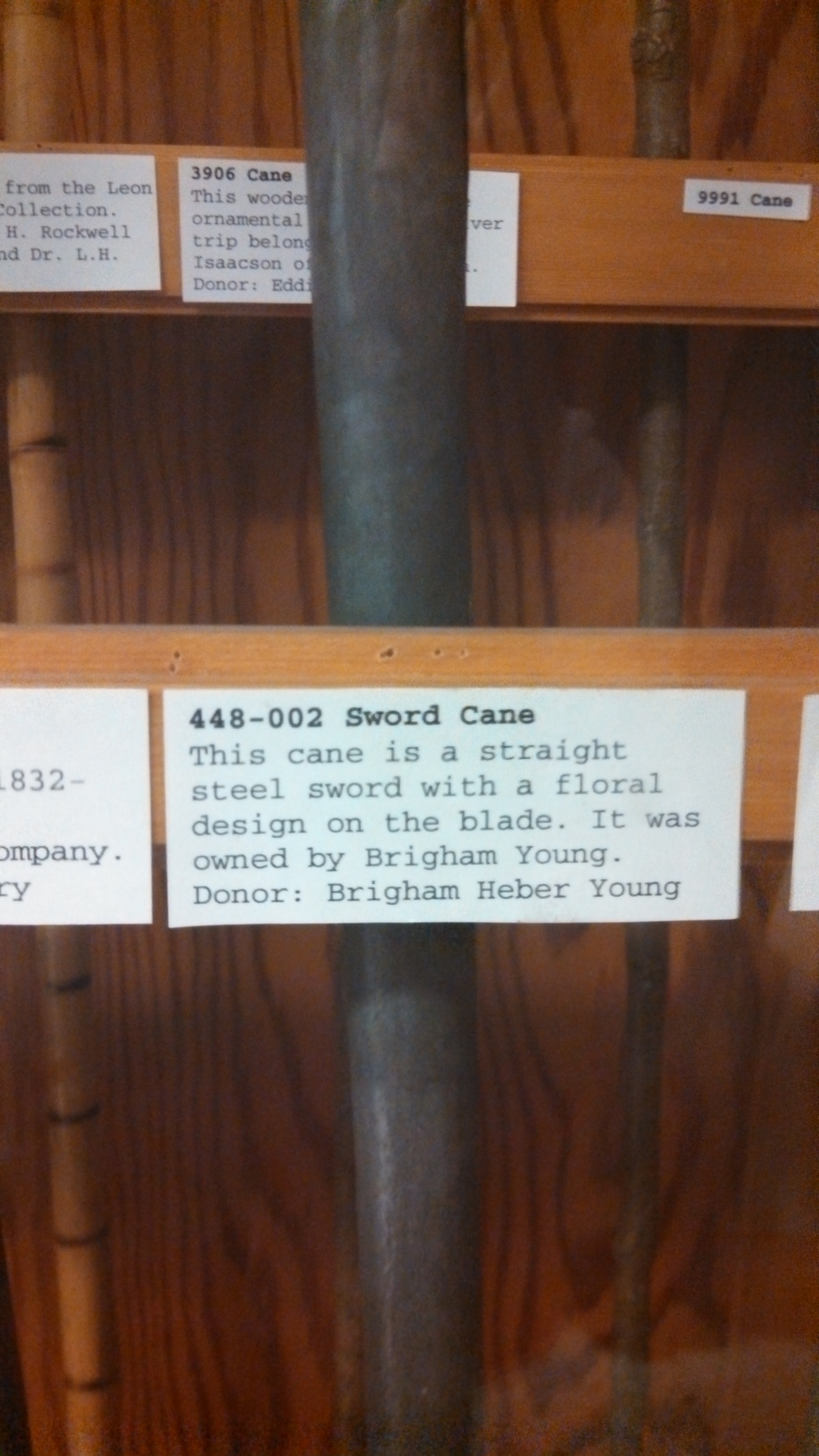
It wasn’t Brigham’s sword cane:

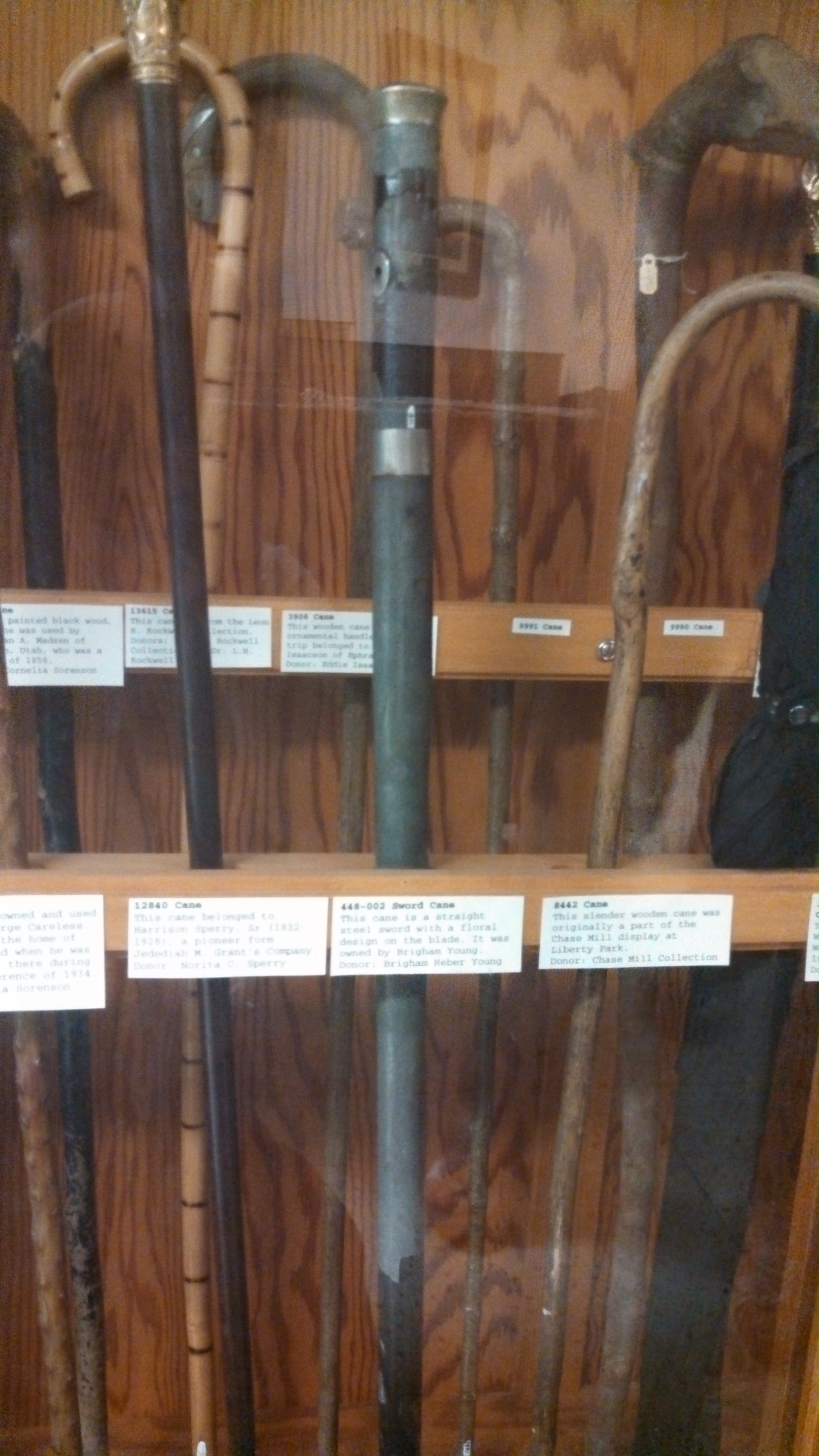
Brigham Young Sword Cane

“This cane is a straight steel sword… Donor: Brigham Heber Young”

Brigham Young Sword Cane full

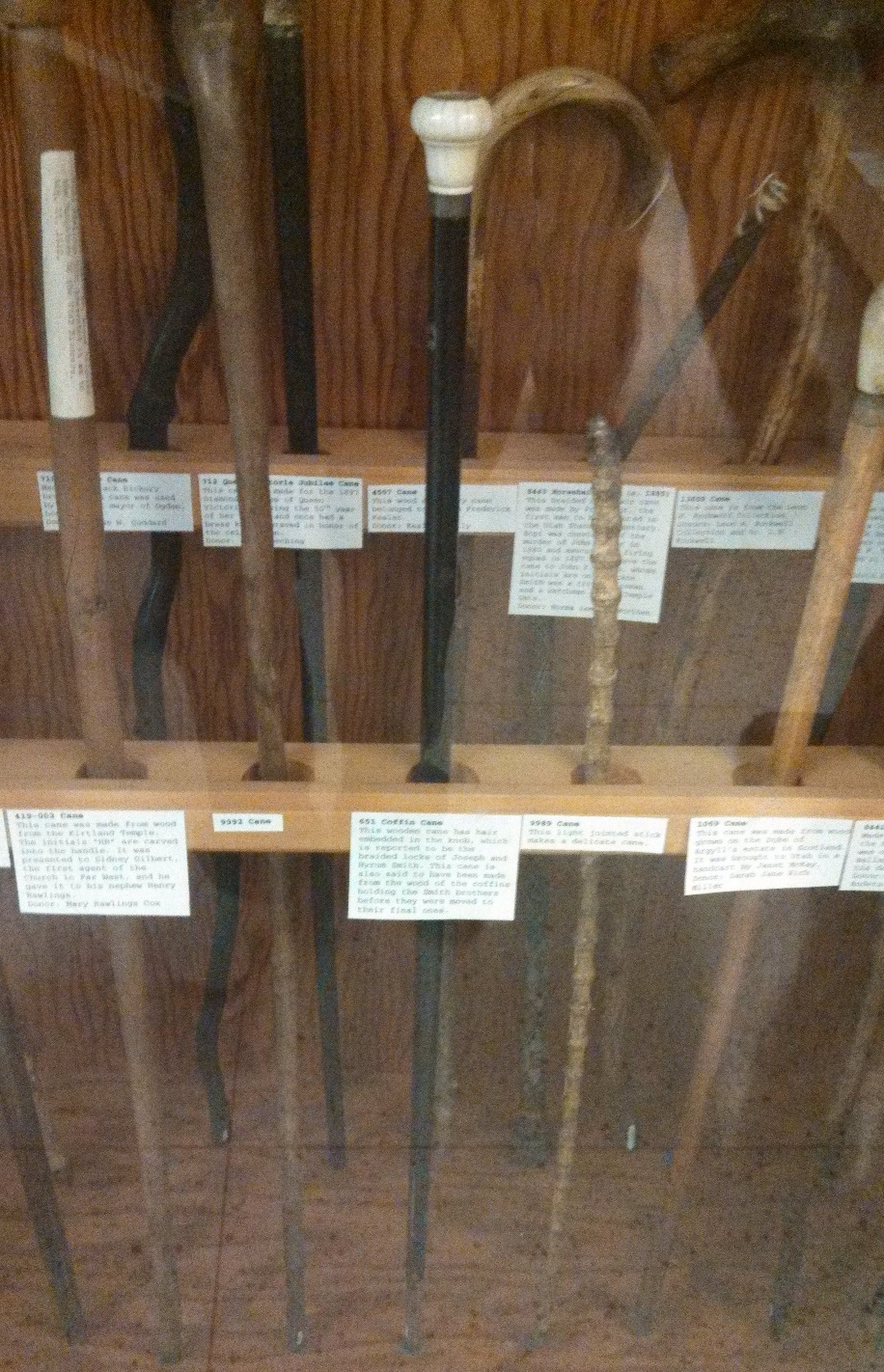
In the Daughters of Utah Pioneers Museum, there is one other cane that belonged to Brigham, although doubtless he had many others:

Brigham Young Cane, silver top, dousing rod

A look from the rear.

This cane differs from all the others in a particular way. It is black, not oak or metal, and has a silver top put over the top of the cane. I read once a description (that I can no longer find) of Oliver’s dousing rod. It was described as “black.” This walking stick was also shorter than Brigham’s other walking sticks. I don’t know if Oliver was shorter than Brigham, but, if so, this may indicate that this is THE stick Phineas Young gave to Brigham and was used to point out the temple lot via dousing.

An apologist states, “It should be noted that Cowdery was probably not a hazel rodder. He seems to have had a staff.” He gives no source and no further discussion on how he comes to this conclusion. Perhaps he had access to more info in the vault?

Oliver was excommunicated in 1838, about the time Brigham and Heber received real rods from Joseph, meaning before the casket sticks were made (as Joseph would have been dead). They received their casket sticks from Emma. Heber is reported using this rod in 1844. The Kimball family has no idea where this rod is, but perhaps it was the one owned by the A. A. Kimball line discussed above.

Orson Hyde

One of the original twelve apostles in modern times, Orson Hyde apparently had the use of a similar rod. Hyde had made the journey to Jerusalem to dedicate Palestine for the return of the Jews. He writes, “On the top of Mount Olives I erected a pile of stones as a witness according to the ancient custom. On what was anciently called Mount Zion, where the Temple stood, I erected another, and used the rod according to the prediction upon my head.”

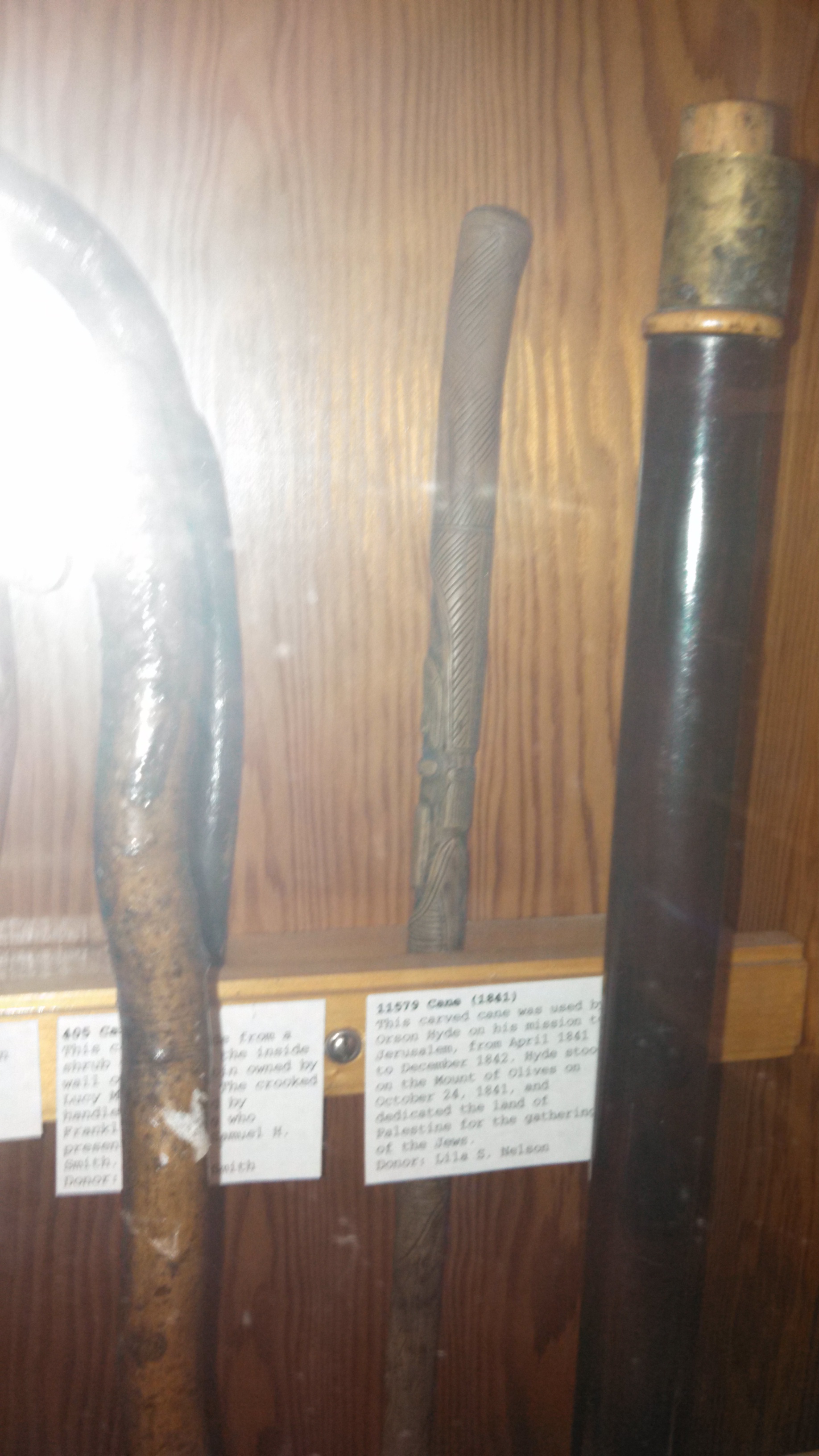
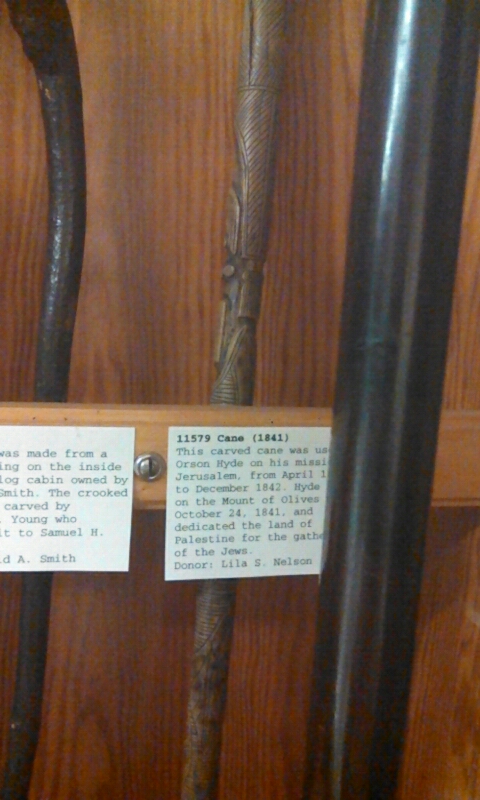
Oliver Hyde Jerusalem Cane

We found the cane spoken of by Orson at the Utah Daughters of Pioneers Museum.

Orson Hyde Jerusalem Cane (2)

Plaque on the cane reads: “11579 cane (1841)
This carved cane was used by orson Hyde on his mission to Jerusalem.
Donor: Lila E. Nelson”

Joseph Smith, Sr. consecrating dousing rods in the Kirtland Temple

Jesse Smith’s 1829 letter to Hyrum Smith suggests that Joseph, Sr. possessed a magical rod, left “the land of Vermont” to pursue “golden gods,” and, most significantly, practiced “necromancy.”

James C. Brewster publishes his claim that, as part of an 1836 Ohio treasure-quest, Presiding Patriarch Joseph Smith, Sr., “anointed the mineral rods and seeing stones with consecrated oil, and prayed over them in the house of the Lord in Kirtland” (Quinn, D. Michael, The Mormon Hierarchy: Origins of Power, Appendix 7: Selected Chronology of the Church of Jesus Christ of Latter-day Saints, 1830-47).

Top of Kirtland temple cane

This cane was made out of a piece of the Kirtland Temple, it says, but perhaps it was simply blessed in the Kirtland Temple. After all, the Kirtland Temple still stands.

Kirtland Temple Cane

Second Kirtland Temple Cane.

Willard Richards

Parley P. Pratt’s autobiography carries an illustration of Willard Richards holding his cane, which looks similar to the Huntington cane. Enlarging the image in The Restored Church makes this clearer.

Willard Richards' Kirtland temple cane

The caption calls this his “Kirtland Temple Cane,” but it resembles the casket sticks. I’m not sure which it really is.

 Do the rods really work?

On the efficacy of dowsing, for the believer who wants to say, “Maybe God really works through rods.”

TL;DR: Mormons really believed in magic sticks, like wands in Harry Potter. Several of these are on display in the Utah Daughters of Pioneers Museum.  Images in this post come from a tour of that museum. One such walking stick, listed here, might even be the dowsing rod used to select the location for the temple.

Posted in Early Church History (1800s) | 12 Comments

Bishop’s Interview Timeline

[Updated with specific language for the different years from the 1930’s forward in response to Joseph Bishop MTC sex scandal – 3/27/2018]

1830-1840 – Biography of Edward Partridge shows no evidence of temple interviews whatsoever. A recommend is set up by revelation to go to the land of zion, but it is a financial qualification recommend, on 12 November, 1831

1830 – In 1830, on average, Americans consumed 1.7 bottles of hard liquor per week, three times the amount consumed in 2010.

1846 – Maine becomes first state to have statewide prohibition

29 May, 1832 A recommend is required to go up to Zion. This recommend is barely spiritual, but far more financial in nature.

The saints will remember that the bishop in the land of Zion will not receive any, as wise stewards, without they bring a recommend from the bishop in Ohio, or from three elders. The elders, therefore, will be careful not to recommend and send up churches to this place without first receiving information from the bishop in Ohio, or in the land of Zion, that they can be accommodated when they arrive so as to be settled without confusion, which would produce pestilence.

1854 Joseph F. Smith was sent on a mission to avoid legal issues as he had beat up the schoolmaster and likely took up drink and tobacco. There was no interview with a bishop, and he would not have passed if there had been one.

1856-1857 –  “During the reformation (LDS) of 1856-1857, bishops and teachers saw to the catechizations interviews, and rebaptism of members.” Everyone is asked to “recommit” to the church. This is the beginning of the “worthiness interview” as we know it.

Some of the early questions were: Have you Murdered anyone in Cold-Blood? Have you knowingly branded another persons cattle or livestock? Have you plowed or harvested grain from a field that was not your own? Do you, and your family, wash or bathe as regularly as you are able?

1856 – Temple recommend questions. The First Presidency sent a letter stating that those recommended by local leaders should:

be those who pray, who pay their tithing from year to year; who live the lives of saints from day to day; setting good examples before their neighbors. Men and women, boys and girls over 16 years of age who are living the lives of saints, believer in the plurality [plural marriage], and do not speak evil of the authorities of the Church, and possess true integrity towards their friends (Spring 1998. History of LDS Temple Admission Standards. The Journal of Mormon History. 135-175).

There was no temple in Utah yet, so the questions were simply asked by home teachers as part of the reformation.

1857 – First list of questions drafted and used to qualify whether an individual could enter the Endowment House.


1879 – Image of a recommend from this time period featured prominently on this blog.

1883 – School of prophets decried masturbation (self pollution) as a poor substitute for polygamy (1981. Salt Lake City School of the Prophets Minute Book, 1883. Palm Desert: ULC Press, 54).

1886 – The First Presidency instructed, among other things, that it is “inconsistent to carry the smell of whiskey and tobacco into the sacred precincts of the Lord’s House” (Spring 1998. History of LDS Temple Admission Standards. The Journal of Mormon History. 135-175).

Tithing was made a requirement for a temple recommend at about the same time, if not in the same letter.

1889 Anson Bowen Call got all the way to the temple engaged to a second wife, without having instruction from a bishop. No interviews are mentioned, or his third and fourth wives after the manifesto would surely have come up.

5 May, 1898  The First Presidency and Twelve discussed the Word of Wisdom. One member read, from the twelfth volume of the Journal of Discourses, a statement by Brigham Young that seemed to support the notion that the Word of Wisdom was a commandment of God. Lorenzo Snow, then President of the Council of the Twelve agreed, saying that he believed the Word of Wisdom was a commandment and that it should be carried out to the letter. There was no definite action except to prohibit eating too much meat. http://www.dialoguejournal.com/wp-content/uploads/sbi/articles/Dialogue_V14N03_80.pdf

1899Lorenzo Snow went on a tithing raising tour throughout southern Utah. Tithing was reemphasized for temple attendance (St. George temple, Logan Temple, and Salt Lake temple were the only ones in operation at this time).

11 May, 1900 – Interview for second anointing text:

Now with regard to your full blessings[,] you will have to see Bro. [Anthony W.] Ivins [president of the Colonia Juarez Stake] and get your recommends to the blessings of the House of the Lord for your full blessings. They will have to be endorsed by Pres[iden]t [Lorenzo] Snow, which I shall be pleased to get for you[,] and that will all be O.K. for you all to get your blessings. Anything I can do for you at any time I shall be happy to do. — George Teasdale to Joseph C. Bently, May 11, 1900 in Joseph T. Bentley, Life and Letters of Joseph C. Bentley: A Biography (Provo: By the Author, 1977), 108.

June 1902 – William Clayton writes:

[T]he practice of masturbation was indulged in by many young people in the church schools. Pres. Smith remarked that this was a most damnable and pernicious practice, and the face of every apostle, president of a stake, and high councillor [sic] should be set as flint against it. The priesthood should be called together at the stake conferences and the brethren and parents should be instructed and warned in relation to this matter.” (Larson, S. A Ministry of Meetings: The Apostolic Diaries of Rudger Clawson, p. 411.)

See also the counsel of Reed Smoot at a similar meeting on pg. 414, where it was called a “secret vice.” The Word of Wisdom was added to the official temple requirements at this point. The First Presidency and Twelve agreed not to fellowship anyone who operated or frequented saloons. Old men were given a pass, and drunkards would be disfellowshipped.

mid-1905 Members of the Twelve were actively using Stake Conference
visits to promote adherence to the Word of Wisdom.

President Joseph F. Smith instructs that sealings for the dead cannot be performed except for those who were married in life. Also, ordinances for the dead are not to be performed for those who committed murder, suicide, or were excommunicates except by permission of the temple president. (See “LDS Temple Worship” by Anderson)

July 5, 1906 – the First Presidency and Twelve substituted water for wine in the sacrament in their temple meetings, apparently beginning July 5, 1906 (Dialogue, vol. 14, no. 3, Autumn, 1981, p. 79)

May 26, 1908North Carolina enacts statewide prohibition, first southern state to do so

5 January, 1908  Richard W. Young, president of the Ensign Stake, and Joseph F. Smith both endorsed Prohibition (Edward H. Anderson, “Events and Comments,” Improvement Era, January, 1908, pp.234-36; Lund Journal, January 3, 1908; Grant Diary, January 5, 1908).

28 December, 1915 – President Smith said in a letter that young “or middle-aged men
who have had experience in the Church should not be ordained to the Priesthood nor recommended to the privileges of the House of the Lord unless they
will abstain from the use of tobacco and intoxicating drinks.”

1917 – Utah had outlawed alcohol, and tobacco became the focus of the Word of Wisdom  (Joseph F. Smith to C. Elmo Cluff, December 28, 1915, Joseph F. Smith Letterbooks, ChurchArchives; Improvement Era, March 16, 1916, p. 461; ibid., April, 1917, pp. 555-58; ibid., Novem-88 I DIALOGUE: A Journal of Mormon Thought October, 1917, pp. 11, 64; ibid., March 1919, pp. 371-80; Relief Society Magazine, February, 1918, p.160; April, 1919, pp. 238-39; February, 1918, p. 146; September, 1919, pp. 527, 593).

1918 – Heber J. Grant becomes prophet.

October 28, 1919 –  Volstead Act passes stating that beer, wine, or other intoxicating malt or vinous liquors” meant any beverage that was more than 0.5% alcohol by volume. The Act also stated that owning any item designed to manufacture alcohol was illegal and it set specific fines and jail sentences for violating Prohibition.

1921  Church leadership made adherence to the Word of Wisdom a requirement for admission to the temple. Before this stake presidents and bishops had been encouraged to in this matter, but exceptions had been made. (Dialogue, page 82)

March 1921 – Members turned away from the temple for tobacco use.

1921 and 1933 – The adherence to the Word of Wisdom for full fellowship in the Church was made even more explicit in manuals and talks.

1934 –  “It is important that all those who may desire to enter the temple for endowments or other ordinances, should observe the law of tithing. The applicant should also observe all other principles of the Gospel, should keep the Word of Wisdom, not use profanity, should not join nor be a member of any secret oath-bound organization and should sustain without reservation the general and local authorities of the church.” (Handbook of Instructions 1934)

1928 – General Handbook of Instructions says that tithing should be encouraged by bishops for those wishing to attend the temple. http://www.dialoguejournal.com/wp-content/uploads/sbi/articles/Dialogue_V14N03_80.pdf

January 1930 – Heber J. Grant says that young men going on missions are not to use tobacco (JH, January 29, April 9, and June 8, 1930; Improvement Era, August, 1930, pp. 659-60).

1933 – General Handbook makes tithing non-optional, requiring prior observance of the principle of tithing as well as:  

The applicant should also observe all other principles of the Gospel, should keep the Word of Wisdom, not use profanity, should not join nor be a member of any secret oath bound organization and should sustain without reservation the general and local authorities of the church. http://www.dialoguejournal.com/wp-content/uploads/sbi/articles/Dialogue_V14N03_80.pdf

1934 – Bootlegging and liquor drinking listed in General Handbook as offenses worthy of a Bishop’s Court. http://www.dialoguejournal.com/wp-content/uploads/sbi/articles/Dialogue_V14N03_80.pdf

1941Recommend questions (link broken).

“[Recommends] are not to be issued to persons who do not sustain the General Authorities of the Church; who are not honest tithepayers or who do not undertake to become honest tithepayers, as distinguished from part tithepayers or token payers; who do not observe the Word of Wisdom or express a willingness to undertake to observe the Word of Wisdom; and who are not otherwise fully worthy by believing in and living the gospel…” (Handbook of Instructions, 1944)

1956 Masturbation was not mentioned in General Conference until 1956, where it was referred to as “self-abuse” (Delbert L. Stapley, Conference Report, October 1956, Afternoon Meeting pg. 121).

1930s-1960s Since ward teachers were ward officers and personal representatives of the bishop, the bishopric personally selected and interviewed the ward teachers, and conducted monthly report meetings with them.

With the introduction of the Welfare Services program in the late 1930s, bishops established and operated ward welfare projects and mobilized ward support for stake projects. http://eom.byu.edu/index.php/Bishop,_History_of_the_Office

“Considered a letter…about issuing temple recommends to non-tithe payers. I explained that people who go to the temple should be full tithe payers and should observe the Word of Wisdom; that as a matter of fact, it is a question of their faith. Men who have a testimony of the Gospel and believe it should contribute to it and if they fail to keep their promise to observe these commandments the Bishop has a right to withhold the recommend, not wholly on the failure to pay tithing but because of their lack of faith in the Gospel. Their failure to pay tithing would indicate their lack of faith in the Gospel.” (David O. McKay diary, July 9, 1954)

1960s – To help new bishops, the church published a wide array of instruction manuals for its various organizations and activities. By the 1980s, new bishops in the United States received several such manuals, a General Handbook of Instructions, and various priesthood guidebooks. http://eom.byu.edu/index.php/Bishop,_History_of_the_Office

“No person should receive a recommend for any purpose unless he is believed to be worthy in every respect. Unworthiness disqualifies him. Before issuing recommends bishops will assure themselves by searching inquiry that the recipients are free from all kinds of immoral practices; that they have no affiliation, in sympathy or otherwise, with any of the apostate groups that are running counter to the established order of the Church; that they sustain local and General Authorities of the Church; are full tithepayers, or will covenant to become such; that they observe the Word of Wisdom, abstaining from tea, coffee, tobacco, and liquor; and that they are fully worthy as evidenced by their observance of the whole gospel law including abiding by all conditions of their temple obligations.” (General Handbook of Instructions, Number 18 1960)

1964 – As part of a new church emphasis on correlation, “ward teaching,” now known as home teaching, became a responsibility of Melchizedek priesthood quorum leaders. http://eom.byu.edu/index.php/Bishop,_History_of_the_Office

August 30th, 1966 – 1st Presidency announces to stake presidents and missions that those who work at casinos are not to have administrative callings or temple recommends.

1970s – “Honest in your dealings with your fellow man” added.

February 12, 1971

“A searching interview should be conducted by the bishop and also by the stake president to determine whether or not—1. The applicant has a testimony of the Gospel. 2. He supports local and General Authorities. 3. Accepts and follows the teachings and programs of the Church. 4. Keep[s] the Word of Wisdom, uses drugs. 5. He is morally clean—free from adultery, fornication, homosexuality. 6. He is in good standing in the Church. 7. He is free from legal entanglements.” (1st Presidency letter)

1976- “Before issuing a recommend the bishop will assure himself by searching inquiry of the worthiness of the applicant in relation to the standards and principles of the Church. These may include the following questions:

  • 1. Are you morally clean and worthy to enter the temple?
  • 2. Will you and do you sustain the local and General Authorities of the Church, and will you live in accordance with the accepted rules and doctrines of the Church?
  • 3. Do you have any connection, in sympathy or otherwise, with any of the apostate groups or individuals who are running counter to the accepted rules and doctrines of the Church?
  • 4. Are you a full tithe payer?
  • 5. Are you honest in your dealings with your fellowmen?
  • 6. Do you keep the Word of Wisdom?
  • 7. Do you wear the regulation garments?
  • 8. Will you earnestly strive to do your duty in the Church; to attend your sacrament, priesthood, and other meetings; and to obey the rules, laws, and commandments of the gospel?
  • 9. Have you ever been denied a recommend to any temple?
  • 10. Have you ever been divorced?
  • 11. Has there ever been a major transgression in your life that has not been confessed and adjusted?” (General Handbook of Instructions 1976)

1978 N. Eldon Tanner gave a talk mentioning that when his father was a bishop, he could not tell if it was a father’s interview or a bishop’s interview. Interviews have a specific purpose: “interview whether a man is worthy for advancement in the priesthood, worthy to fill a mission, or worthy to go to the temple.”

No standard questions were mentioned, but vague attempts to “determine through discussion with him what the Lord would want as an ambassador to represent Him and His church. Let him explain, for instance, what the Lord would want in a missionary with regard to the Word of Wisdom, with regard to morality, honesty, dependability, tithing, obedience, devotion, etc.” are suggested.

Serious transgressions must go to a General Authority.

There is mention of asking “those questions.”

“It is not in order for a priesthood leader to list in detail ugly, deviant, or bestial practices and then cross-examine a member of the Church as to whether or not such things are practiced.”

1978 – The First Presidency added a statement to the temple recommend questions that indicated that those who had not repented of “impure, unholy, or unnatural sex acts” could not receive a recommend (First Presidency letter, June 9, 1976, Church Archives; General Handbook of Instructions, supp. 3 to #21 [March 1, 1978], pg. 4 as cited in Kimball, E. L [2005] Lengthen Your Stride, Working Draft).

1980s – The church consolidated all ward meetings, previously spread throughout the week, into one, three-hour block on Sunday. http://eom.byu.edu/index.php/Bishop,_History_of_the_Office

1980s – The church adds child support and alimony to the temple recommend questions. (personal interviews with church leaders)

1980 – BYU now requires a bishop’s interview.

January 5, 1982 – Oral sex named as an act that would deny one a recommend even in marriage

“Married persons should understand that if in their marital relations they are guilty of unnatural, impure, or unholy practices, they should not enter the temple unless and until they repent and discontinue any such practices….The First Presidency has interpreted oral sex as constituting an unnatural, impure, or unholy practice.” (First Presidency letter)

October 15, 1982 – The First Presidency sent a letter  recinding the ban on oral sex stating that bishops,

“should never inquire into personal, intimate matters involving marital relations between man and his wife.” This counsel is still contained in temple recommend instructions (Kimball, E. L. [1998] The History of LDS Temple Admission Standards. Journal of Mormon History Spring pg. 135-175).

November 1982 – L. Tom Perry gave first satellite broadcast, a talk titled, “For a Bishop Must Be Blameless.” In the talk, he mentioned that he sat on a committee to revamp the duties of a bishop. More than likely, the bishop’s interview was revamped at this time to be a standard set of questions.

1985The temple recommend question was simplified to, “Do you live the law of Chastity?” from “unnatural acts.”

June 1986 – “Your Friend the Bishop” printed in New Era in 1986. The article explains that a bishop’s interview is something to look forward to, and that back when “priesthood meeting was in the morning, and sacrament meeting was much later in the day,” the speaker saw an interview with a bishop. The interview described was a welfare visit, and is placed in the 1950s time frame. The interview with the teen is unstructured, and certainly has nothing to do with sexual purity. Despite being requoted by Henry Eyring in 2002, the original text of this article in the New Era is NOT available on LDS.org.

The article states, “My bishop never interviewed me the same way twice, and your bishop will be inspired as he interviews you. There isn’t a fixed set of questions.”

April 1987 – “No Shortcuts,” a talk by Robert L. Simpson, indicates that priesthood interviews are not a violation of agency. Has a priest state as much to show how clear that concept is.

1987 Yearly bishop’s interviews required for BYU students.

April 1990 – Hinckley included “the demand [of] offensive intimate relations” in the definition of abuse during the priesthood session of General Conference.

April 1991 – L. Tom Perry gave talk about interviews in which he described his first interview with his father, the bishop: “The interview resulted in a little scripture study between myself and my father.

2 July, 1991 – “[R]itualist child abuse” memo surfaces from Bishop Pace. Interviews conducted in 1989-1990 could have influenced temple ritual modifications.

1992 – The Liahona featured an article selling the ideas of the interview, and confessing in confidence, to kids.

1996 – The first question about a belief in God, Jesus Christ, and the Holy Ghost was split into three questions. A second question was modified to ask if the member sustained the First Presidency and Quorum of the Twelve as prophets, seers, and revelators. The question about wearing the garments was qualified– a clause was added about wearing them as instructed in the temple.

1998 – General Handbook published stating that, “sexual relations within marriage are divinely approved not only for the purpose of procreation, but also as a means of expressing love and strengthening emotional and spiritual bonds between husband and wife.” Extra-marital petting and masturbation are not mentioned specifically in the General Handbook of Instruction. Pornography was added. (Source 1998 copy of the GHI]

1999A simplified question about financial obligations was asked of all members, not just divorced members.

2000 Book of Mormon study guide announced Alma 45 is a bishop/father’s interview.

21 January, 2004 – 2004 BYU NewsNet article (now BYU Universe), “LDS Church [is] not opposed to birth control.”

2012 The question about wearing garments was slightly modified to clarify that the garments should not be worn separately.

Posted in Timelines | 1 Comment